
Finding The Best Odds On Trump
- Patrick

- Oct 31, 2024
- 6 min read
Updated: May 23
One of the many interesting things about the 2024 election is that it appears prediction markets have surpassed traditional opinion polling as the best way to track the race. This is an exciting shift for the future of politics and the future of elections.
Markets have always been the single best predictive tool thanks to their ability to harness the wisdom of crowds. A famous example was seen in the aftermath of the 1986 Space Challenger Disaster. At the time there were four listed companies that were contractors for the NASA Space Program - Lockheed, Martin Marietta, Morton Thiokol and Rockwell International. Unsurprisingly, each company sold off abruptly in the first few minutes after the explosion that morning. Curiously, three of the companies recovered and only ended the day down 2-5% on 2-3x their average daily volume while Morton Thiokol ended the day down 12% on over 17x its average daily volume. A commission was formed to conduct a thorough investigation that involved thousands of hours of interviews and millions of pages of documents. After five months they released their finding that a fault in the O-rings manufactured by Morton Thiokol was the primary cause of the crash.
While betting markets on elections have been around for some time, liquidity was always somewhat limited by regulatory or geographical factors. Now that liquidity has reached billions of dollars a year, there is a strong incentive for differentiated research and price discovery rather than relying on readily available public information. An example of this has been seen in commodity markets over the last fifty years. As volumes increased from millions to billions of dollars per day, proprietary trading firms invented creative ways to gain an information advantage - measuring shadows on the roof of oil storage tanks, launching private satellites to monitor crop harvests or even setting up makeshift weather stations in particular areas. The result of this has been more accurate and transparent pricing of food, fuel and materials.
While a broad consensus of opinion polling has Harris with a narrow 2-3 point lead over Trump in the popular vote that would translate into a tossup in the electoral college, prediction markets have consistently leaned towards Trump with his recent odds of being the next President above 60%. It has been particularly interesting to note prediction market odds seem to react more to early voting data, which have showed big swings towards republicans compared to 2020. While I don't have a differentiated opinion to the prediction markets, they can be used as a benchmark to go looking for better odds in the deepest, darkest corners of the stock market.
Trilogy Metals
Trilogy Metals (NYSE: TMQ / TSX: TMQ) owns 50% of Ambler Metals LLC, a joint-venture with South32. Ambler Metals owns two of the highest-grade copper deposits in the world located in the Ambler Mining District in remote northwest Alaska.
The rapid proliferation of data centres, electric vehicles and batteries has led to significant demand for copper. Despite this, there are limited new projects coming online and the copper market is expected to be in a structural deficit over the next twenty years. While Ambler Metals can partially contribute to closing this deficit, the deposits are geographically isolated and located hundreds of miles from the nearest road. In order for a mine to be feasible, a viable form of transportation needs to be established. The Alaska Industrial Development and Export Authority (AIDEA) proposed and secured state funding for a 211-mile private industrial access road back in 2013. Since the road crosses lands owned and/or managed by federal, state, municipal and private entities there was a long and drawn out regulatory approval process. Finally in 2020, the Trump administration's Bureau of Land Management (BLM) provided the final approval for the road along with the required Environmental Impact Statement (EIS). Shortly thereafter environmental groups challenged the validity of the EIS which forced the BLM to complete a Supplementary Environmental Impact Statement (SEIS). By the time the SEIS was completed in 2023, BLM had undergone a change in management under the Biden administration. The SEIS found that there would be a worse environment impact on wildlife than the original EIS stated and recommended "no action" on the proposed road, reversing the prior approval. This decision drew criticism from industry groups, Alaska's state government, senators and congressional representatives. There are ongoing legal challenges to the "no action" decision currently being brought by the state of Alaska.
In his campaign Trump has promised to re-approve the Ambler Road. The current governor of Alaska Mike Dunleavy has also been rumoured as a potential candidate for Secretary of Interior, who oversees BLM.
Superior Value Proposition
Ambler Metals owns two distinct copper deposits. The largest is called Arctic and has had a Pre-Feasability Study (PFS) released that estimated it could produce 10,000 tons of ore per day over a lifespan of 13 years. After accounting for upfront and operating costs, the project was deemed to have a Net Present Value (NPV) of $1.1b using a 8% discount rate and current copper spot prices. The second deposit is called Bornite and has a PFS scheduled to be released later this year, so we will ignore this for now. Focusing on the Arctic deposit, Trilogy's 50% ownership and shares outstanding imply a $3.44 NPV per share, compared to the current share price of just $0.62. For any pre-production mining project a Risk Weighting (RW) is necessary to generate a target share price. The purpose of the RW is to capture factors that impact the value of the project but are not captured by the NPV.
Some reasons the RW should be greater than 100% (ie - the NPV understates the value of the project) includes:
The NPV uses todays copper prices, whereas the structural supply shortage over the coming years means copper prices will likely be higher by the time the project is active
The Arctic deposit has extended areas that have not yet been explored and may contain more material that can be mined
No value for the Bornite deposit is included in the NPV. While Bornite is only half as big as Arctic, it should theoretically have some positive value
Some reasons the RW should be less than 100% (ie - the NPV overstates the value of the project) includes:
Even in the event Trump wins, there is no guarantee the road will be approved and completed within the next administration
The mine may be more costly to build than the NPV assumes
There may be less copper in the deposit than the NPV assumes
The mine may take longer to build and start producing copper later than the NPV assumes
Ultimately I decided on a 50-75% RW based on gut feeling. Generally a copper project in a high quality jurisdiction deserves a RW of 100%, so I feel this is adequately conservative. At 50% RW Trilogy's target share price if Trump wins is $1.72.
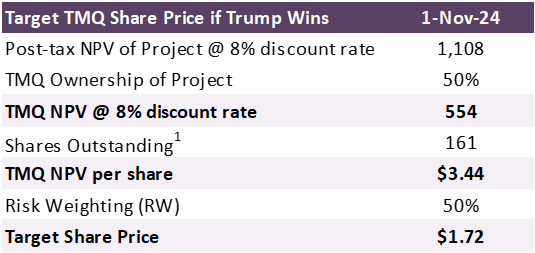
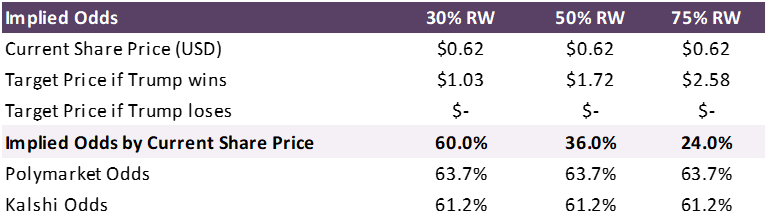
Using Trump's current probability of winning on Polymarket and Kalshi of roughly 60%, we can back solve that the market is currently pricing Trilogy with a 30% RW - this would generate a target share price of $1.03 and match the payout available on the prediction markets. Based on my range of a 50-75% RW, the equivalent odds would have Trump priced at between 24-36% of winning the election which is superior to the prediction markets. As an extra layer of conservatism this also assumes Trilogy is worthless if Trump loses which is unlikely to be true.
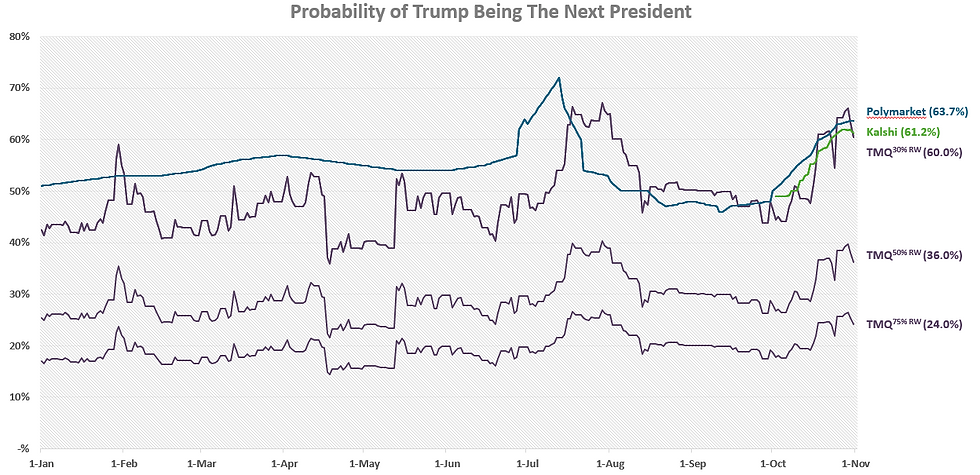
Below is a visual representation of the odds available for Trump based on Polymarket, Kalshi and Trilogy Metals at various risk weightings throughout the course of the election campaign.
Ultimately there are a lot of ways to indirectly bet on a Trump victory using the financial markets rather than prediction markets. His policy positions are well publicised and include providing a more friendly regulatory environment for crypto and energy, cutting government spending, introducing tariffs on imports and rescinding climate subsidies.
The clear risk with this strategy is that each policy has second and third order impacts that may be difficult to quantify. For example Tesla CEO Elon Musk has been one of Trump's biggest supporters. If Trump wins you might expect Tesla's share price to go up because the company's CEO is now friends with the President. With that being said, Trump's insistence that climate subsidies need to be rescinded would obviously be bad for Tesla and Elon Musk has repeatedly said he has not backed Trump for business reasons. It's difficult to determine if Tesla would be better off under a Trump administration and then quantifying that into a forecasted change in share price.
To this effect, in 2016 Jane Street built a proprietary data stream that allowed them to receive the vote count on election night before the television networks and most other people following the race. They correctly predicted a Trump victory before anyone else but thought the shocking result would lead to Armageddon in financial markets so they shorted the S&P500. Instead the S&P500 rose and they ended up losing a significant amount of money. There is a certain safety in what prediction markets are offering that can help avoid this.
Nevertheless, the 1637 Fund has taken a stake in Trilogy Metals (NYSE: TMQ).